Why Are They Rebuilding Ocean City’s Beaches in the Middle of Summer?
Hey Folks,
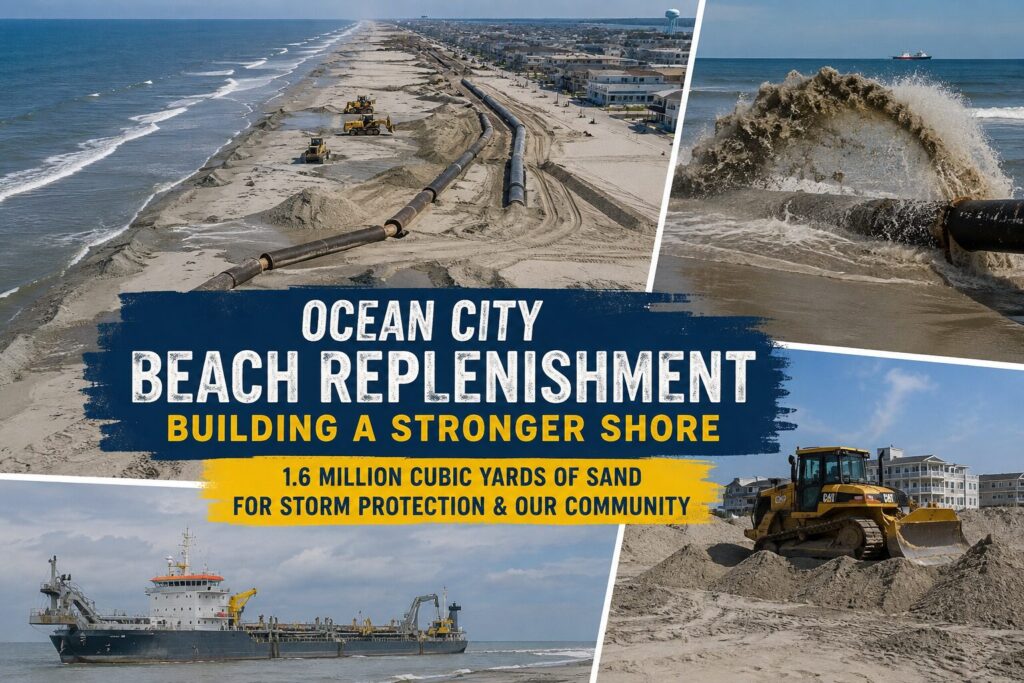
If you’ve been anywhere near the north end of Ocean City lately, you’ve probably seen the pipes, bulldozers, mountains of sand and a few beach entrances temporarily closed.
And I know what some of you are thinking:
Why in the world are they doing a massive beach replenishment project in July and August? – I’ll get to that..
This is a $19.5 million federal coastal storm-protection project involving more than 1.6 million cubic yards of sand, and it’s part of a program protecting Ocean City that goes back more than three decades.
This Is Much Bigger Than Making the Beach Wider
The official name is the Great Egg Harbor and Peck Beach (Ocean City) Coastal Storm Risk Management Project.
The U.S. Army Corps of Engineers awarded a $19.5 million contract to Great Lakes Dredge & Dock Company for the 2026 replenishment.
The job calls for more than 1.6 million cubic yards of sand to be dredged from an offshore borrow area near Great Egg Harbor Inlet, pumped through pipelines onto the beach and shaped into an elevated protective berm.
That’s an incredible amount of sand. Put another way, 1.6 million cubic yards would equal roughly 107,000 loads from 15-cubic-yard dump trucks.
Fortunately, nobody is trying to drive 107,000 dump trucks down the Boardwalk.
The project stretches from approximately 12th Street north to the Seaview Road groin area. According to the Army Corps, construction began July 7 and is expected to continue into early September 2026, although weather, equipment and other logistical issues can always affect that schedule.
So Why Do We Keep Putting Sand Back?
Here’s something that gets lost whenever we talk about beach replenishment:
This isn’t primarily about creating a nicer beach for your umbrella and beach chair.
It’s about storm protection.
A wide, elevated beach provides a buffer between the Atlantic Ocean and Ocean City’s homes, businesses, streets, utilities and infrastructure. During hurricanes, nor’easters and other coastal storms, that sand absorbs wave energy and erosion that otherwise could occur farther inland.
And yes, some of that sand eventually moves.
That’s actually expected.
The Army Corps’ Ocean City/Peck Beach project information says the original project required approximately 6.2 million cubic yards of sand, with periodic nourishment of about 1.1 million cubic yards every three years.
The original project was completed in 1992, and the beach has been nourished and repaired repeatedly since then. Ocean City says this is the 11th north-end renourishment under its long-term agreement with the Army Corps.
So when somebody says, “Didn’t they put sand there before?” the answer is:
Yes. That’s how the system is designed to work.
Where Does All That Sand Come From?
This part is pretty interesting.
The sand isn’t being hauled into Ocean City from somewhere inland. It comes from an offshore borrow area about 5,000 feet off Great Egg Harbor Inlet.
A dredge removes the material offshore, mixes it with water and pumps it through pipeline onto the beach. Heavy equipment then moves and grades the sand into the engineered beach profile.
There’s even a secondary benefit. According to the Army Corps, periodically dredging that offshore ebb-shoal area can help alleviate navigation difficulties around the inlet.
Now to the $19.5 Million Question: Why Summer?
If you own a business, rent a house, take your family to Ocean City every summer or simply love spending August on the beach, seeing construction equipment and closed beach entrances during peak season doesn’t exactly sound ideal.
But after looking through the project history and the federal information, this does not appear to be a case of Ocean City simply deciding that July would be a wonderful time to start moving 1.6 million cubic yards of sand.
The Army Corps awarded the construction contract on June 1, 2026, and at that time announced that construction was expected to begin in early July.
This is a federally managed project involving funding, engineering, environmental requirements, contracting, dredging equipment and the availability of highly specialized contractors and vessels.
There’s another practical consideration too: getting the protective beach rebuilt ahead of the fall storm season has real value.
Would everybody prefer to have this work finished before Memorial Day? Of course.
But if the choice is dealing with temporary summer inconvenience or delaying a major federally supported storm-protection project, I can understand why the work is moving forward.
They’re Not Closing the Whole North End
This may be the most important thing for anybody visiting Ocean City right now.
The entire north-end beach is not closed.
The contractor generally keeps the active closure to approximately 1,000 feet of beach — about two blocks — at a time.
Crews pump and grade the sand, complete that section, reopen the rebuilt beach and then move the active construction area farther along the shoreline.
And they’re working 24 hours a day.
Sand ramps are also constructed over the pipeline at beach entrances as completed areas reopen.
That approach allows thousands of people to continue enjoying Ocean City while this massive project moves along a relatively small section of shoreline at any one time.
Where Does the Project Stand?
According to the August 10 update provided to me, sand pumping had reached the area between Ninth and 10th Streets. Beaches at Eighth, Ninth and 10th Streets were affected around the active construction zone, while completed areas farther north had begun reopening. Eleventh Street remained open with guarded swimming.
The first stage of construction is moving south toward 12th Street.
But here’s the part some people may not realize:
When they reach 12th Street, the project isn’t finished.
The operation then reverses direction and works north toward Great Egg Harbor Inlet.
Ocean City is posting changing beach closures and progress reports on its official Beach Replenishment Update page, and that’s the page I’d check before heading to the north-end beaches.
Who’s Paying for It?
The construction cost is shared 65% federally and 35% non-federally, with the New Jersey Department of Environmental Protection serving as the project’s non-federal sponsor.
On a $19.5 million contract, that works out to approximately $12.675 million in federal funding and $6.825 million in non-federal funding.
One important distinction: that does not mean Ocean City taxpayers simply receive a $6.825 million bill. The NJDEP is the formal non-federal sponsor, and the funding arrangement is broader than that.
The Bigger Picture
I think this is one of those Shore stories where two things can be true at the same time.
Doing beach construction during the height of summer is inconvenient.
And…
Having a wide, engineered beach protecting Ocean City before hurricane and nor’easter season is pretty darn important.
If you’ve spent enough time along the Jersey Shore, you’ve seen what Mother Nature can do.
The beach isn’t just where we spend our summer afternoons. It’s part of the first line of defense for the community behind it.
And when this project is complete, Ocean City’s north end should head into the fall with a substantially wider beach and a much larger buffer between the Atlantic and the homes, businesses and infrastructure behind it.
Beach Replenishment at a Glance
- Project cost: $19.5 million
- Sand: More than 1.6 million cubic yards
- Contractor: Great Lakes Dredge & Dock Company
- Project area: Approximately 12th Street north to the Seaview Road groin area
- Construction began: July 7, 2026
- Expected completion: Early September 2026, subject to conditions and delays
- Typical active closure: Approximately 1,000 feet, or about two blocks
- Operations: 24 hours a day
- Purpose: Coastal storm-risk reduction and protection of infrastructure and property
- Funding: 65% federal / 35% non-federal
What’s Coming Up
- Next: Sand placement continues south toward 12th Street.
- After reaching 12th Street: Operations reverse and work north toward Great Egg Harbor Inlet.
- Through early September: Work is currently expected to continue, subject to weather, equipment and logistics.
- Before you hit the beach: Check Ocean City’s daily beach replenishment updates for the latest work-zone and beach-access information.
If you’re heading to Ocean City, don’t let the words “beach replenishment” scare you away. The construction zone moves, completed beaches reopen, and most of Ocean City’s shoreline remains available.
And the next time you’re standing on one of those freshly rebuilt beaches wondering where all that sand came from, you’ll know there’s a lot more engineering — and a lot more money — underneath your beach chair than you might have imagined.
That’s one of the things I love about covering South Jersey. There’s usually a much bigger story behind something we drive or walk past every day.
Help Us Grow The AC Mike Community
If you enjoy these stories and updates from around Atlantic City, Ocean City and the Jersey Shore, I’d appreciate a favor. Please share this newsletter with a friend, family member, coworker or anyone who loves our community.
You and I are building something special here by highlighting the people, places, businesses and stories that make South Jersey unique. Every share and every new subscriber helps us reach more people and shine a brighter spotlight on the positive things happening throughout our region.
If someone forwarded this newsletter to you, be sure to subscribe and join us each week for local stories, events and insider perspectives from around the Shore.
Thank you for being part of the AC Mike community.
Live-Work-Play-AC!
See you on the 48
AC Mike
Thanks for reading AC Mike's Newsletter.
Join the Conversation